- All
- Product Name
- Product Keyword
- Product Model
- Product Summary
- Product Description
- Multi Field Search

Views: 1 Author: Site Editor Publish Time: 2026-10-08 Origin: Site


Expandable polystyrene is a light, stiff foam made from tiny beads. A gas expands the beads, and a mold then shapes them. Manufacturers heat the beads, the gas grows, and the softened beads stick together into the familiar white eps foam. People often call white packaging "styrofoam," but eps is a different product. Fact.MR reports that the building and insulation segment makes up 48.0% of the eps application market in 2026. This shows eps growth in construction. Water and impact do not damage eps, and shipping boxes often contain eps. Recyclers collect eps too. The sections below explain what expanded polystyrene is, the properties of eps, the benefits of eps foam, and the everyday uses of eps.
EPS is a lightweight foam made from tiny beads that expand with heat and stick together.
EPS resists water and absorbs shock, making it great for packaging and insulation.
EPS is strong for its weight, and higher density means more strength.
EPS is cost-effective and used in many products, from cups to building panels.
Choose the right EPS density for your project to get the best performance.
Expandable polystyrene is a light, stiff foam made from polystyrene beads. A gas expands the beads, and a mold then shapes them. The material starts as small resin pellets. Heat softens each pellet, and a trapped blowing agent turns it into a foam full of cells. This simple idea produces a solid with a closed-cell, air-filled structure. Each tiny cell holds air and stays sealed from its neighbors. That structure explains most of the material's properties. The foam resists water, holds its shape under load, and absorbs impact well. A wet box of eps foam still protects the goods inside. A dropped appliance packed in eps often survives the fall.
Producers make eps beads through suspension polymerization. Styrene monomer droplets of roughly 50–500 μm disperse in water with stabilizers such as polyvinyl alcohol and tricalcium phosphate. Initiators like dicumyl peroxide drive polymerization at 90–130°C. During this stage, the blowing agent enters the bead. Pentane is the most common choice, and raw beads generally carry 4–7 wt% of it. The base polymer is polystyrene, a chain of styrene repeat units (C8H8) in an atactic arrangement. Typical molecular weight falls between 130,000 and 220,000 Daltons, and the melt flow index sits at 20–30 g/10 min. These figures shape how the beads behave in later processing.
Steam does the expanding. In a pre-expander, steam at roughly 100–120°C softens the polymer while the pentane vaporizes. Each bead puffs up, and volume can grow up to 50 times the original. The expanded polystyrene moulding process then moves to aging. Freshly expanded beads rest in silos for about 6–24 hours, typically 12. Air diffuses into the cells, internal pressure equalizes, and residual pentane drops from around 3% to below 1%. This step prevents shrinkage and gives the beads resilience for fusion.
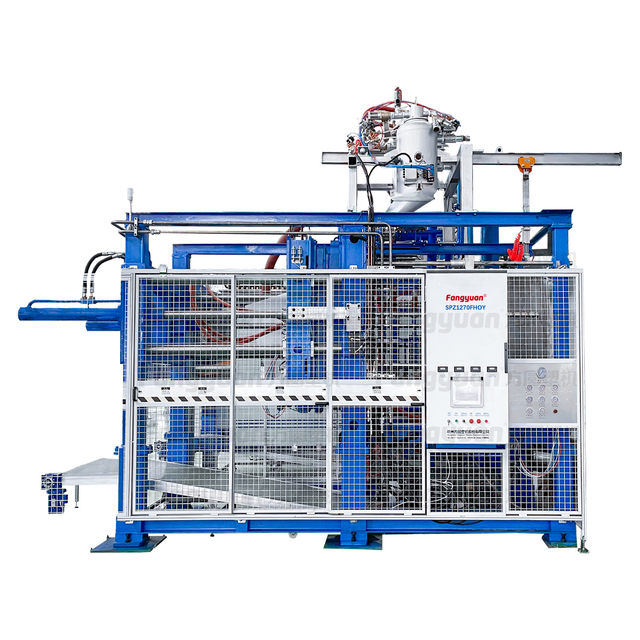
Conditioned eps beads travel pneumatically into a pre-heated mold cut to the product's shape. Controlled injection, sometimes with vacuum assist, fills the cavity evenly. High-temperature steam at about 110–130°C then enters through steam chests. The residual pentane re-vaporizes, the beads soften and re-expand, and they press together into one closed-cell piece. Cooling water follows, which solidifies the polystyrene and locks in dimensional stability before ejection. A shape molding cycle runs about 45–90 seconds.
The finished part carries the same properties throughout its body. Density, cell size, and fusion quality all depend on how carefully each stage runs. A well-made eps foam block shows uniform cells and strong bead bonding. Poor fusion leaves gaps that weaken the part. Buyers who understand what is expanded polystyrene can judge quality by looking at cell structure and surface finish. The expanded (e) polystyrene family also includes many grades tuned for different applications. Packaging, construction, and food service each draw on a specific grade. Common applications reward the same core traits: low weight, good insulation, and reliable shock absorption.
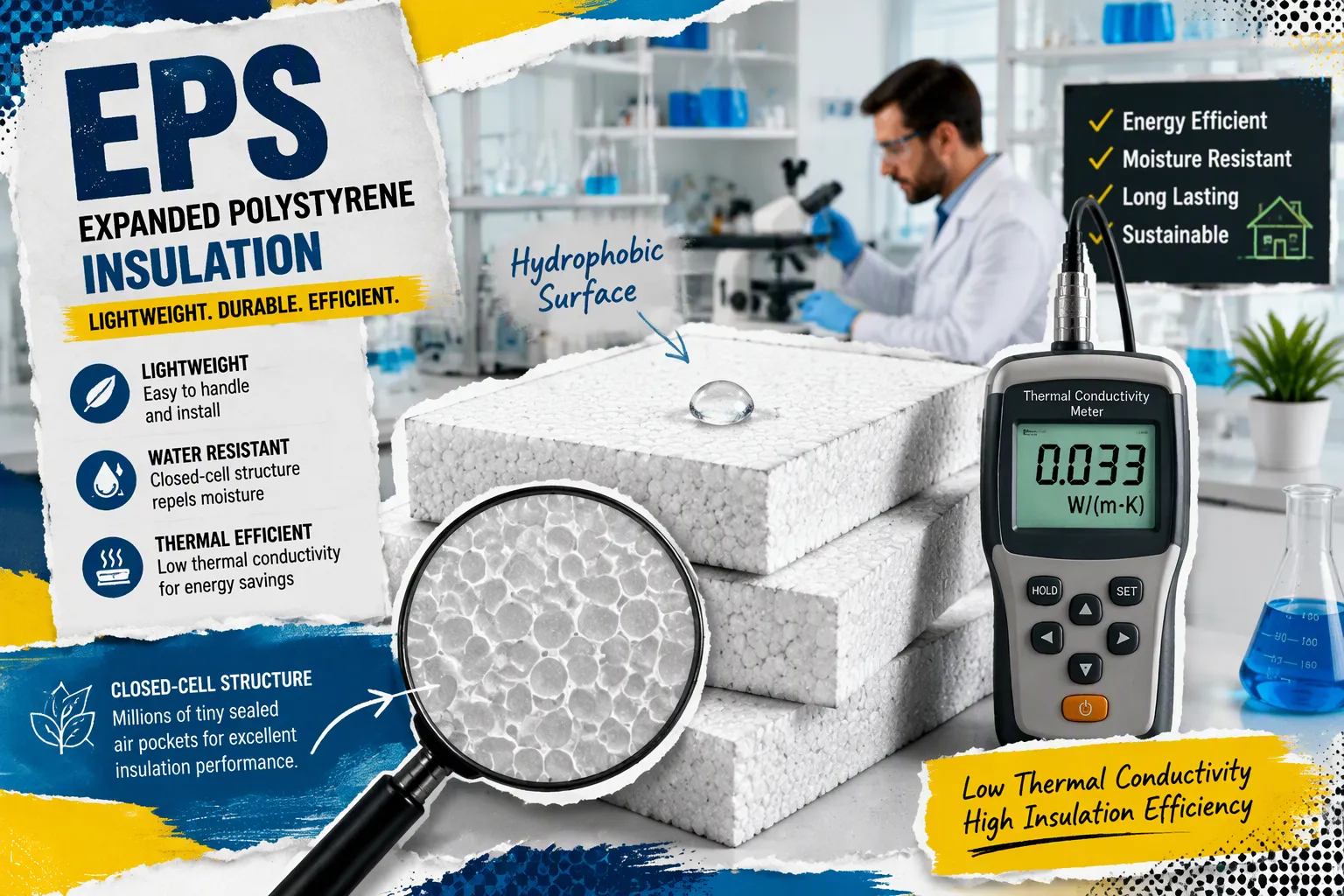
The expanded polystyrene material properties that matter most in real projects fit into two groups. One group covers heat flow and moisture. The other covers mechanical strength and buoyancy. Both groups come back to the same closed-cell structure described earlier. Each cell keeps its air sealed off from its neighbors. That one design choice drives the insulation properties and the load-bearing behavior of the material.
Air trapped in sealed cells gives eps its low thermal conductivity. Less solid polymer and more still air slow heat transfer through the board. Thermal conductivity for eps foam sits between 0.030 and 0.038 W/(m·K) across the common density range of 15–30 kg/m³. A 20 kg/m³ grade measures 0.033–0.035 W/(m·K) at a 10°C mean temperature. A 30 kg/m³ grade reaches 0.030–0.032 W/(m·K). These values make the material a dependable insulating plastic foam material for walls, roofs, and floors.
Mechanism | How it contributes to water resistance or thermal insulation |
|---|---|
Non-interconnected closed cells | Sealed air pockets block water from passing through the bulk and preserve insulating value in damp conditions |
Hydrophobic polystyrene cell walls | The base polymer repels water, so cell walls do not absorb or bond with water molecules |
Low density and high air content | Less solid material and more trapped air lower thermal conductivity and limit water absorption pathways |
Low water absorption rate | Typically below 2% by volume even after prolonged submersion, keeping structure and R-value stable over time |
Field data back up these claims. Testing by the Energy Materials Testing Laboratories (EMTL) showed that EPS installed in well-constructed roofs absorbed an average of only 0.2% moisture by weight under prolonged cold, damp winter conditions, with little or no effect on compressive or flexural strength. The material retained between 95% and 97% of its thermal efficiency. Similarly, the Minnesota Department of Public Service found seven-year-old EPS foundation samples with moisture levels of only 0.13%, again retaining 95–97% of thermal efficiency.
Moisture barely dents the thermal insulation of well-installed eps, and the material keeps most of its strength after years of wet, cold service.
Long-term exposure still deserves attention. Cyclic wetting and drying can raise moisture content over time, and that rise cuts thermal performance and compressive strength. The ASTM C1512-10 (2020) protocol captures this effect through 28 days of preconditioning at 24 °C and 90% relative humidity, followed by freeze–thaw cycling in a cold room at −15 °C. Designers who plan for drainage and drying protect the insulation properties of eps across a building's life.
Density sets the strength of eps. Compressive stress at 10% compression climbs from 13 psi at 1.0 pcf to 80 psi at 4.0 pcf. Mid-range grades follow the same trend: 1.5 pcf reaches 24 psi, 2.0 pcf reaches 30 psi, and 3.0 pcf reaches 64 psi.
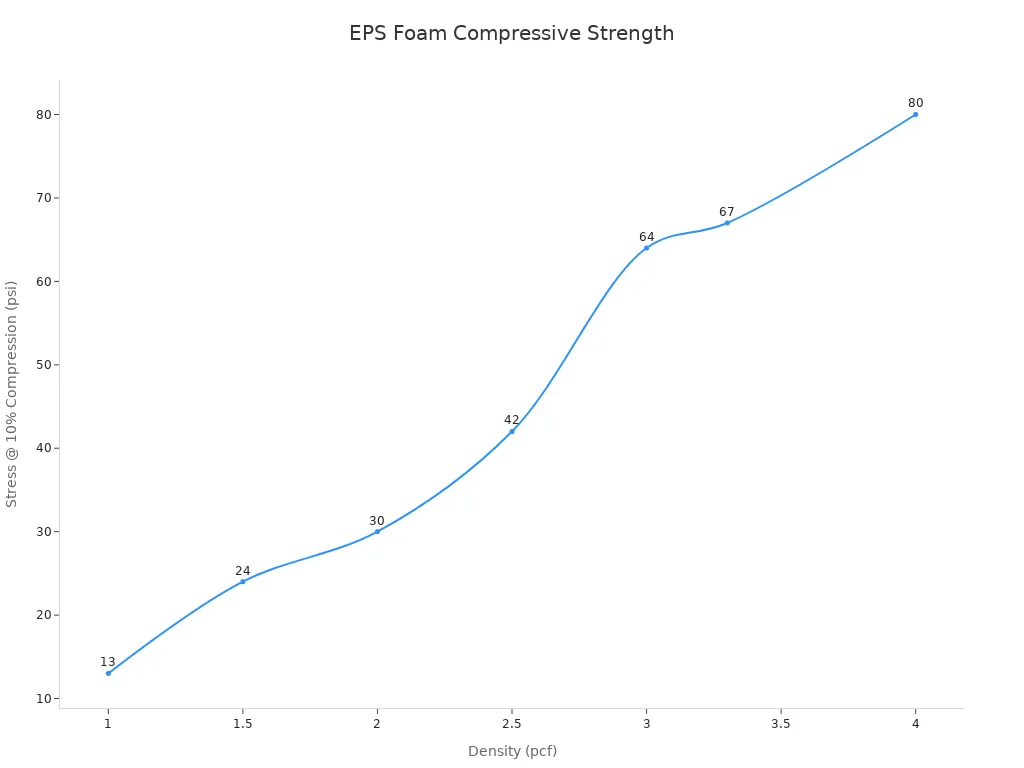
ASTM C578 sorts these grades into types. Type I at 0.90 pcf carries 10 psi, Type VIII at 1.15 pcf carries 13 psi, Type II at 1.35 pcf carries 15 psi, and Type IX at 1.80 pcf carries 25 psi. Most construction applications work within 10–60 psi, and higher density pushes resistance toward the top of that band.
These physical properties support tough, impact-resistant parts that resist aging well. The same closed cells that block water also trap air for flotation. Buoyancy makes eps a common choice for dock floats, life-raft components, and marine fenders. Water resistance and temperature cycling tolerance keep those parts working season after season. Engineers who match density to load get durable performance from a very light foam.
The properties, uses and processing of this material all connect in one practical story. A light bead turns into a rigid part, and that part moves through factories and job sites with little effort. The benefits of eps begin with weight and end with cost.
Low density gives eps foam its cushioning role. A high air content makes each part very light, so workers move boxes and panels with ease. Industry sources note that this low weight means less mass must be moved during shipping. That directly cuts the fuel and energy needed for transport and lowers related emissions. Lightweight materials also matter in weight-sensitive fields such as automotive and aerospace, where less weight means lower fuel use.
EPS products are very easy to handle and ship within the logistics chain.
Their light weight lowers transportation and installation costs.
Builders gain from faster delivery and distribution across the job site, which improves overall efficiency.
Cushioning performance holds up well indoors. Protected from sunlight and moisture, the cellular structure stays stable for 10–20 years or longer. Outdoor exposure without a protective coating tells a different story. UV radiation and temperature swings cause surface brittleness and lower impact absorption within a few years. Repeated heavy compression shortens service life too, because cells compress permanently and lose thickness.
Processing efficiency keeps costs low across many applications. Molded shapes come out of the tool ready to use, and scrap rates stay modest with good fusion. That versatility serves packaging, construction, and food service alike. Packaging materials made from eps protect goods in transit, and insulated panel systems rely on the same foam for thermal performance.
Construction Application | Typical Lifespan | Aging Notes |
|---|---|---|
Covered in walls and roofs | 30–50 years or longer | Coverings block sun and rain; R-value stays stable |
Underground or below-grade | May exceed 50 years | Darkness and steady temperature minimize degradation |
Fully encapsulated in ICF walls | Theoretically indefinite | No air, light, or water reaches the foam |
These physical properties reward smart grade selection. A buyer who matches density to load gets durable insulation and reliable protection. The material's continued relevance rests on this balance of low weight, stable performance, and simple processing.
EPS packaging is a common sight in shipping because it soaks up shock. A drop test at 30 inches with 1.5-inch samples shows how it compares with other packaging materials. EPS carries an optimal static load of 0.82 lb/sq in and delivers a peak G-force of 51. That result sits close to recycled PE foam at 55 and layered corrugated pads at 46. Starch-based planks reach 72, which means more force reaches the product inside.
Material | Optimal Static Load (lb/sq in) | Corresponding G-force |
|---|---|---|
EPS | 0.82 | 51 |
Recycled PE Foam | 0.37 | 55 |
High-Density Starch-Based Plank | 0.64 | 72 |
Layered Corrugated Pads | 0.52 | 46 |
The same tests show that eps foam keeps its cushioning under extreme temperature and humidity. That stability supports expanded polystyrene (eps) in construction, where insulated panel systems line facades, walls, roofs, and floors. These panels combine structural support with thermal insulation, and the foam core supplies construction insulation without adding much weight. Builders also use the material as a lightweight fill material behind retaining walls and under roadways. Expanded polystyrene in construction keeps its properties across decades of covered service, and that record explains its steady role in building envelopes.
Food service draws on the same traits. Common applications include cups for hot and cold drinks, trays, clamshells, and disposable containers for delivery and catering. Molded cup grades serve coffee shops and fast-casual restaurants. Biodegradable EPS grades now cover cups, clamshells, and other food containers. Protective inserts for electronics and appliances round out the consumer side.
Regulation shapes this market. California restricts producers from selling or distributing EPS food service ware unless the material meets a 25% recycling rate, and statewide sales restrictions took effect on January 1, 2025. The rule covers cups, plates, bowls, hinged containers, clamshells, trays, lidded containers, and lids. It does not cover peanuts, void fill packaging, sports equipment, ice chests, or household insulation. Recycling infrastructure varies by region. The Polystyrene Recycling Alliance and RRS report an EPS recycling rate near 31% across North America for transport packaging, driven by commercial collection. Norway reached 88% in 2023, and Japan and South Korea have stayed above 50% for years. Those figures show how collection systems change outcomes for polystyrene.
Buyers often compare eps and xps for the same job. Both foams are made from polystyrene beads. Both are used for thermal insulation and packaging. The two polystyrene products differ in cell structure and cost. Looking closely at the numbers shows where each one works best for common applications.
XPS has a thermal conductivity near 0.028 W/mK. EPS foam measures 0.033–0.037 W/mK, so XPS insulates a little better in extreme conditions. Lab tests also favor XPS on water pickup. A 24-hour immersion test shows about 0.3% absorption for XPS and under 2% for EPS. EPS dries back to less than 0.3% change within 24 hours after it is taken out of water. Field research tells a more balanced story. The two foams look very similar in moisture performance during service, and EPS kept its R-value even when it was significantly saturated. Independent tests found no loss in R-value or compressive strength for EPS after freeze-thaw exposure. Polystyrene cell walls repel water, and that trait supports the drying behavior. Those properties support dependable service in damp conditions.
Cost often decides the choice. XPS costs 10–30% more than EPS. High-density EPS delivers compressive strength up to 60 psi, which matches the 40–60 psi range of XPS, at a lower price. That gap makes EPS the more cost-effective option for most construction projects. XPS stays competitive only where its specific properties are required. For packaging and general insulation, EPS foam covers the need at a lower price per square foot. The physical properties of each polystyrene foam suit different applications, and matching grade to load matters more than picking a winner. Builders who compare the two polystyrene foams for insulation work often find it the simpler choice, and both still serve construction applications well. A specifier who needs the highest thermal resistance in a thin profile may still prefer XPS.
Expandable polystyrene is a light, rigid foam made from gas-expanded beads. Sealed cells give eps insulation, water resistance, and impact protection. These benefits of eps explain its reach. Eps foam cushions goods in packaging. Eps panels insulate walls and roofs. Eps trays and cups serve food service applications. Eps inserts protect electronics. Buyers should weigh density, bead size, and quality control against the intended application. Eps grades suit different applications, and buyers match each to the load. Packaging and construction remain core eps applications. Eps recycling options and the environmental impact of polystyrene shape sourcing choices. Low-GWP blowing agents and bio-based formulations keep advancing. Eps foam earns its place, and polystyrene demand keeps growing.
Styrene monomer turns into polystyrene beads. During production, a blowing agent like pentane goes into the beads. Then steam softens the beads, and the gas makes them expand. The expanded beads stick together inside a mold. This process turns small resin pellets into a light, stiff foam.
Sealed cells keep water out of the main material. Water absorption usually stays below 2% by volume, even after long soaking. The same cell structure soaks up shock. An appliance dropped while packed in eps often survives the fall. These traits help with many packaging and construction uses.
Common uses include shipping cartons, insulated wall and roof panels, food trays, cups, and protective inserts. Construction uses rely on the foam as lightweight fill and insulation. Food service uses depend on molded cup grades. Packaging uses gain from steady shock absorption during shipping.
Both foams are made from polystyrene. XPS insulates a little better and costs 10–30% more. High-density eps reaches compressive strength up to 60 psi, which matches the XPS range at a lower price. Most projects find eps the cost-effective choice, while thin high-performance profiles may favor XPS.
Buyers should match density to the load they expect. Compressive strength goes up with density, so a heavier grade suits structural work. Bead fusion quality matters too, since poor fusion makes the part weaker. Buyers should also confirm the grade fits the target use and the expected service conditions.